
Private Label Dog Treats Manufacturers: A Complete Buyer’s Guide
How to Choose the Right Private Label Dog Treats Manufacturer
Finding a manufacturer that can produce dog treats is relatively easy.
Finding a manufacturer that can repeatedly produce the right product, meet your target market requirements, support private label packaging and scale with your business is much harder.
For pet brands, distributors, retailers and importers, choosing between private label dog treats manufacturers should therefore involve much more than comparing catalogues and prices.
Your manufacturing partner can affect product consistency, food safety, packaging quality, inventory planning, lead times and ultimately the reputation of your brand.
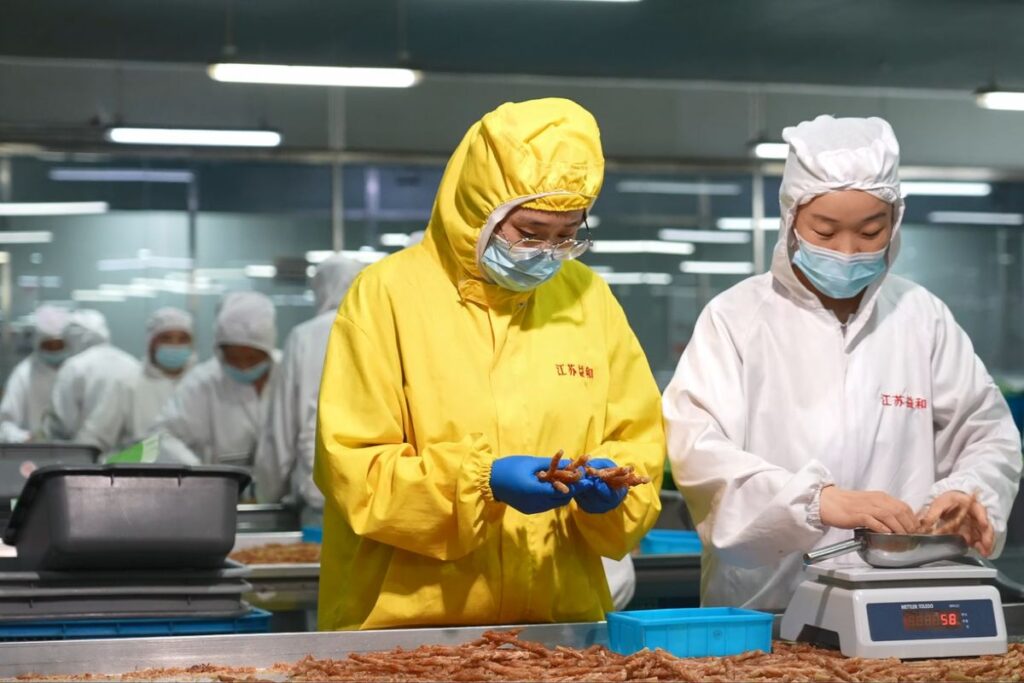
This guide explains how private label dog treat manufacturing works, which product categories to consider, what to ask potential suppliers and how to evaluate an OEM partner before placing a commercial order.
If you already have a product idea, you can also learn more about Matchwell’s OEM and private label pet treat manufacturing and available dog treat categories.
What Is Private Label Dog Treat Manufacturing?
Private label dog treat manufacturing means a third-party factory produces dog treats that another company sells under its own brand.
Depending on the project, a manufacturer may offer an existing product specification, modifications to an established product or a fully customized OEM/ODM development project.
The buyer generally controls the brand, target market, packaging concept and commercial positioning, while the manufacturer handles production according to the agreed specification.
However, the terms white label, private label, OEM and ODM are not always used consistently between suppliers.
What matters is not the terminology itself, but exactly what is included in the project.
| Manufacturing Model | Typical Starting Point | Best Suited For |
|---|---|---|
| White Label | Existing manufacturer product with your branding | Fast market testing |
| Private Label | Established product with branding, packaging or specification changes | Retailers and growing brands |
| OEM | Product manufactured to an agreed buyer specification | Brands requiring stronger differentiation |
| ODM | Manufacturer supports product development as well as production | Buyers developing a new concept |
A custom pouch does not automatically mean the formula is exclusive.
If formula exclusivity, packaging exclusivity or geographic exclusivity matters to your business, these points should be discussed before production and clearly defined in the commercial agreement.
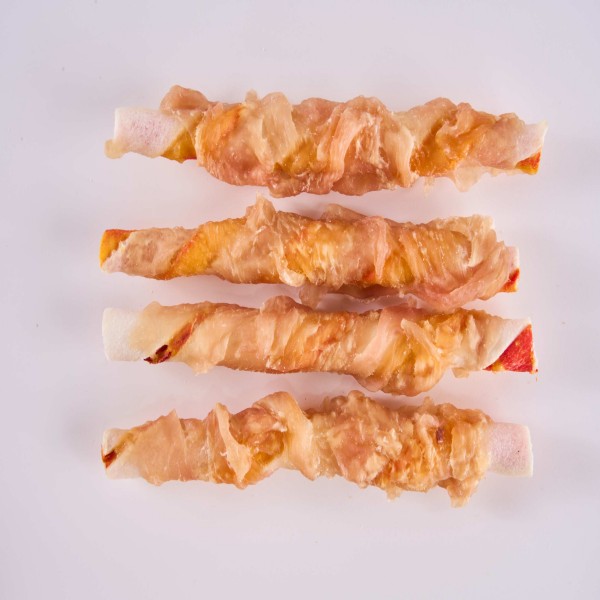
Why Do Pet Brands Use Private Label Manufacturers?
The biggest advantage of private label manufacturing is that a brand can enter the pet treat category without building its own manufacturing facility.
Instead of investing directly in production equipment, laboratory systems, quality management, sourcing networks and factory operations, the buyer can focus more resources on product positioning, distribution and customer acquisition.
Private label manufacturing can also make product development more flexible.
An emerging brand might begin with an established chicken jerky specification and customized packaging. Once sales volumes become more predictable, the same brand may move toward a different protein, custom shape, functional ingredients or a more differentiated formulation.
This makes the manufacturing relationship important beyond the first order.
A suitable partner should support the product you want to launch today while also having enough technical and production capability to support future SKUs.
Start With a Product Brief Before Contacting Manufacturers
One of the most common sourcing mistakes is asking manufacturers for a general catalogue and price list before defining the product.
A better approach is to create a basic sourcing brief first.
The manufacturer should understand your destination market, sales channel, target consumer, preferred protein, treat format, approximate size, pack weight, packaging style, expected order volume and intended price positioning.
For example, a small training reward sold through e-commerce requires a very different product specification from a long-lasting chew intended for specialty pet stores.
A clear product brief also allows different manufacturers to quote against similar requirements, making supplier comparison much more meaningful.
Main Types of Private Label Dog Treats
Different dog treat categories require different equipment, quality controls and technical experience.
A manufacturer that performs well in one category may not necessarily be the strongest partner for another.
Air-Dried and Jerky Dog Treats
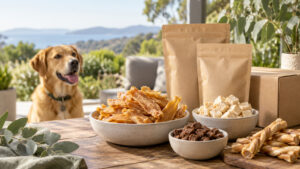
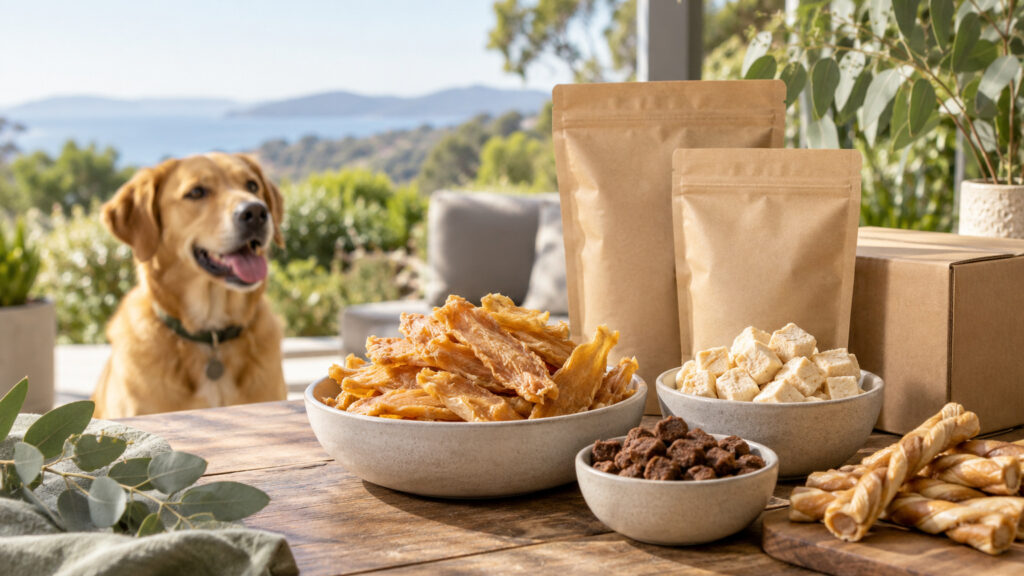
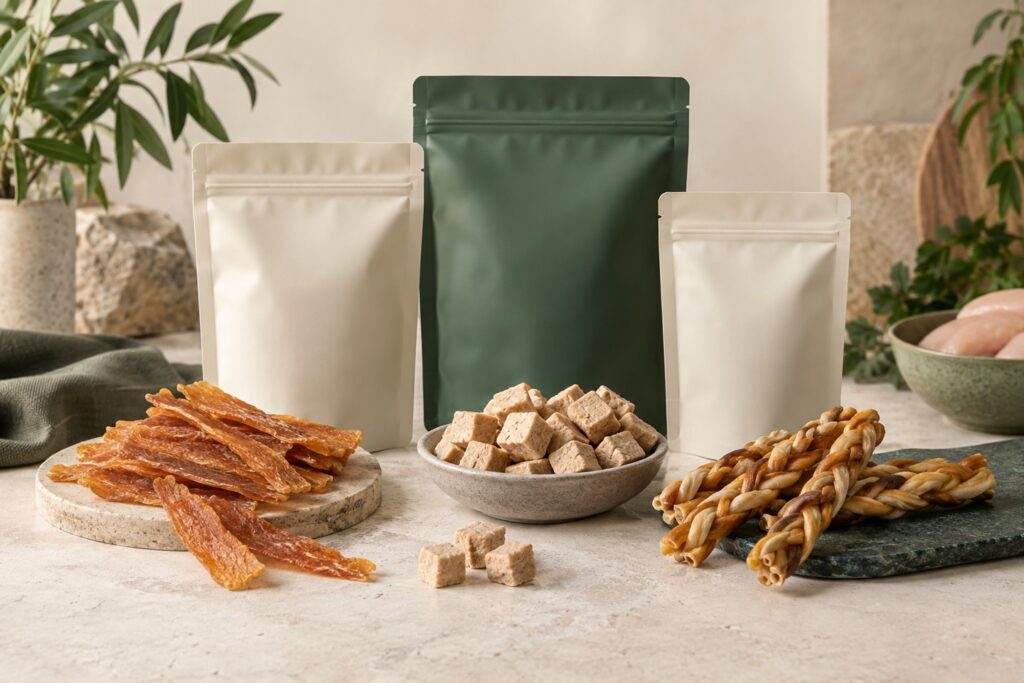
Chicken breast, duck strips, beef pieces and other meat-based treats remain important private label categories.
For these products, buyers should pay particular attention to raw material specifications, meat cutting consistency, drying parameters, moisture control and microbiological testing.
Product appearance can also vary significantly depending on the raw material and drying process, so acceptable tolerances should be agreed before mass production.
Brands considering this category can read Matchwell’s guide to air-dried dog treats for private label brands for additional sourcing considerations.
Freeze-Dried Dog Treats
Freeze-dried products are often positioned as premium, meat-forward treats and can work well for single-protein, limited-ingredient and high-value product lines.
When sourcing freeze-dried treats, buyers should evaluate raw material quality, freeze-drying capacity, final moisture targets, product structure, breakage during shipping and packaging barrier performance.
Because equipment and production conditions differ significantly from conventional dried treats, experience in this specific category matters.
For buyers developing this format, see the private label freeze-dried dog treats OEM guide.
Dog Chews
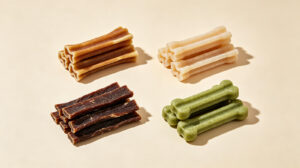
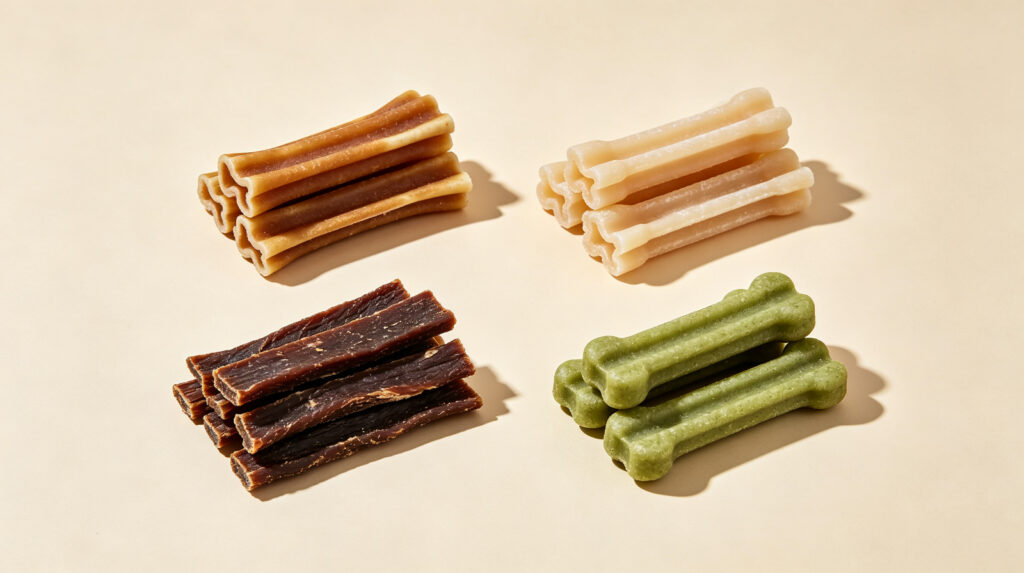
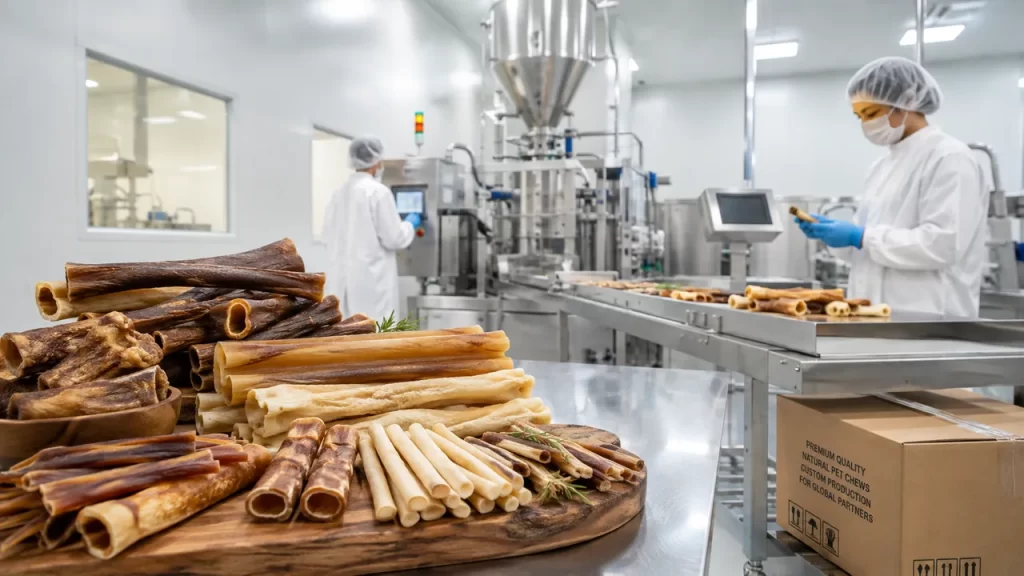
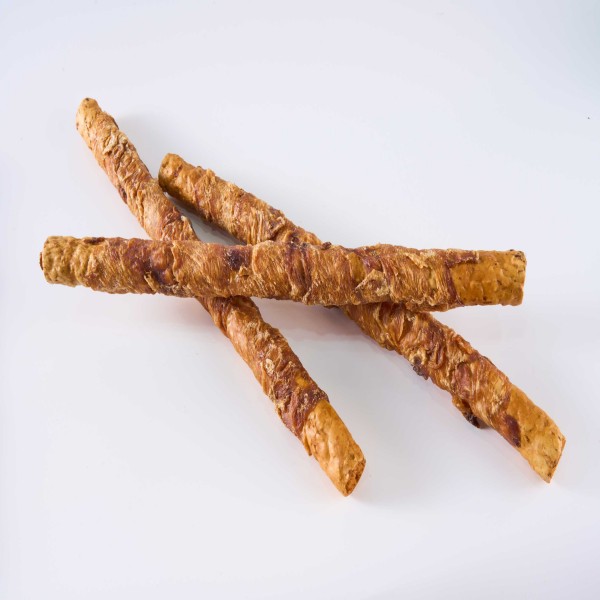
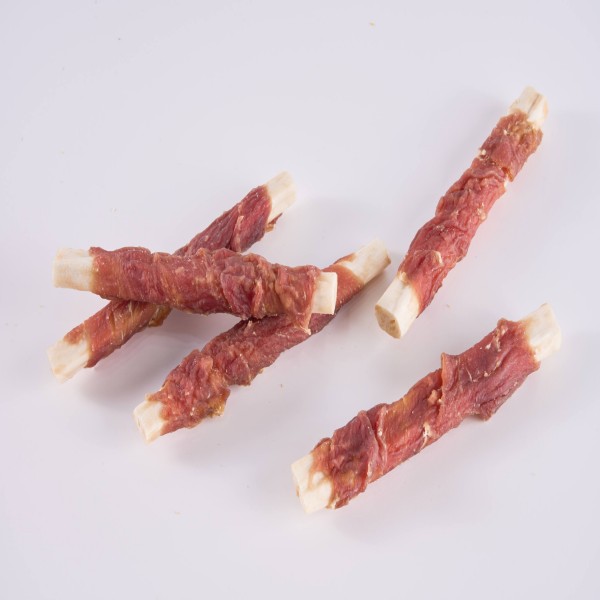
Chews can include rawhide formats, collagen products, meat-wrapped chews and other long-lasting concepts.
Unlike small training treats, chew performance depends heavily on factors such as density, dimensions, drying, texture and piece-to-piece consistency.
The specification should therefore include much more than simply the protein or flavour.
Matchwell’s private label dog chew manufacturing page covers rawhide, collagen and chicken-wrapped formats as well as customization of size, weight, protein and packaging.
Soft and Training Treats
Training treats are generally designed around convenient feeding, smaller portions and repeat use.
For private label buyers, important variables may include piece size, softness, breakability, protein selection, calorie positioning and packaging format.
Consistency is especially important because customers may handle dozens of pieces during a training session.
Functional Treats
Functional dog treats combine the experience of a snack with ingredients selected around a specific product positioning.
When developing this type of product, the manufacturer must consider not only palatability and processing but also ingredient compatibility, permitted claims and destination-market requirements.
If functional nutrition is becoming a separate part of your portfolio, Matchwell also offers private label pet supplement development.
How to Evaluate Private Label Dog Treats Manufacturers
Once the product category is clear, supplier evaluation becomes much easier.
Instead of asking whether a factory is simply “good,” evaluate whether it is appropriate for your specific project.
1. Food Safety Systems and Certifications
Certifications are an important screening tool, particularly for buyers supplying supermarkets, distributors and major retail channels.
Depending on the destination market and buyer requirements, relevant systems may include BRCGS, IFS, ISO 22000 or other recognized food safety and quality management standards.
Do not stop at certification logos on a website.
Ask whether the certificate is current, which production facility it covers and whether the certified scope includes the product you plan to purchase.
Buyers who want to understand this area in more detail can review Matchwell’s guide to dog treat factory certifications.
2. Quality Control and Traceability
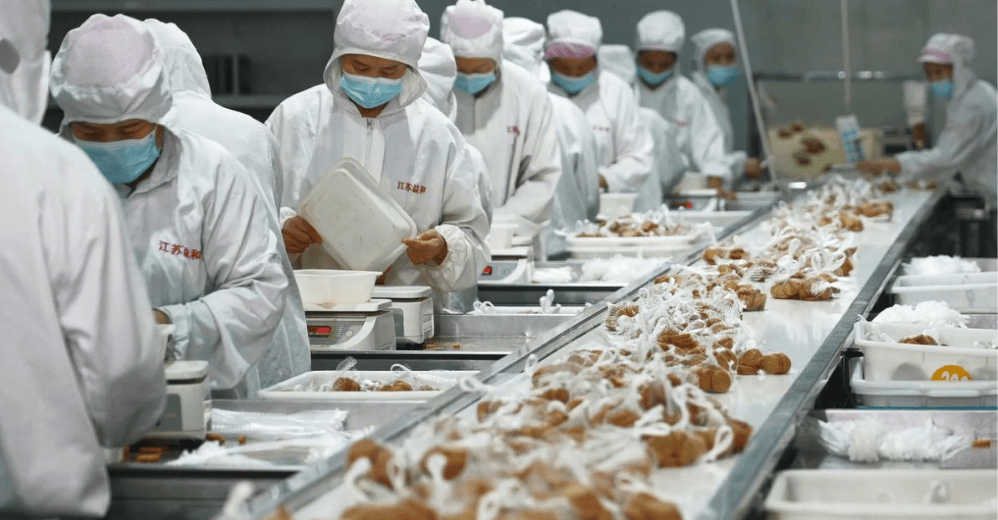
Ask the manufacturer how raw materials are approved, what is checked during production and what tests are performed before a finished batch is released.
A structured quality system should connect incoming ingredients, manufacturing records and finished products through traceable batch information.
The important question is not simply whether the factory has a laboratory.
You need to understand what is actually tested, when it is tested, what specifications are used and what happens when a result falls outside the agreed range.
3. Experience With Your Product Category
A factory may offer dozens of products in a catalogue, but this does not necessarily mean every category is a core manufacturing strength.
Ask how frequently the factory produces your type of product and which processes are performed internally.
If you are sourcing collagen chews, investigate chew manufacturing experience.
If you are developing freeze-dried meat treats, investigate freeze-drying capacity and process controls.
Category-specific experience usually matters more than catalogue size.
4. OEM and R&D Capability
Even if your first SKU is based on an existing product, you may eventually want stronger differentiation.
Discuss which variables can realistically be customized.
This may include protein source, ingredient composition, dimensions, shape, texture, piece weight, flavour system, packaging format and case configuration.
The manufacturer should also explain which requested changes require a new development process and which can be adapted from an existing specification.
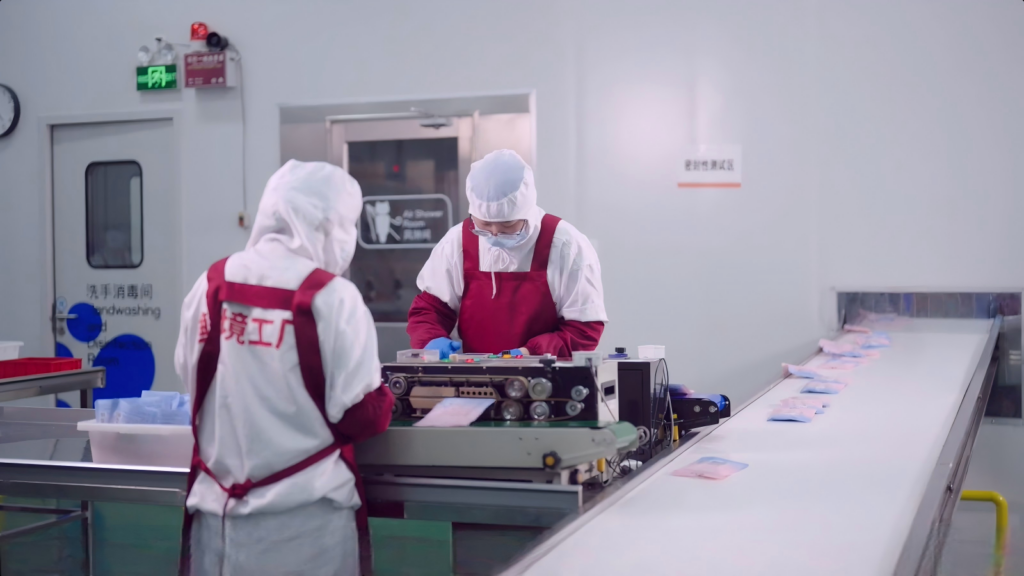
5. Packaging Capability
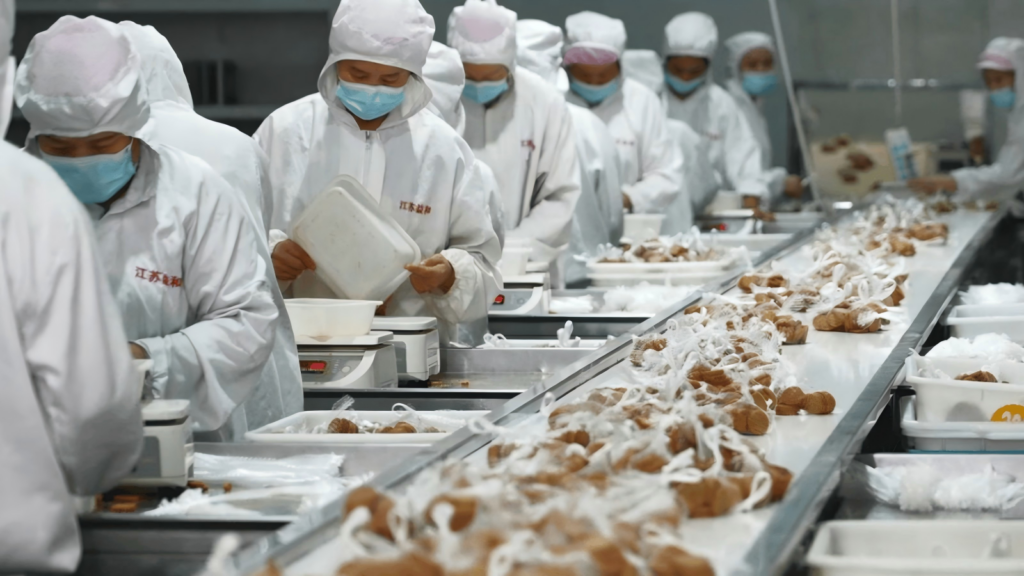
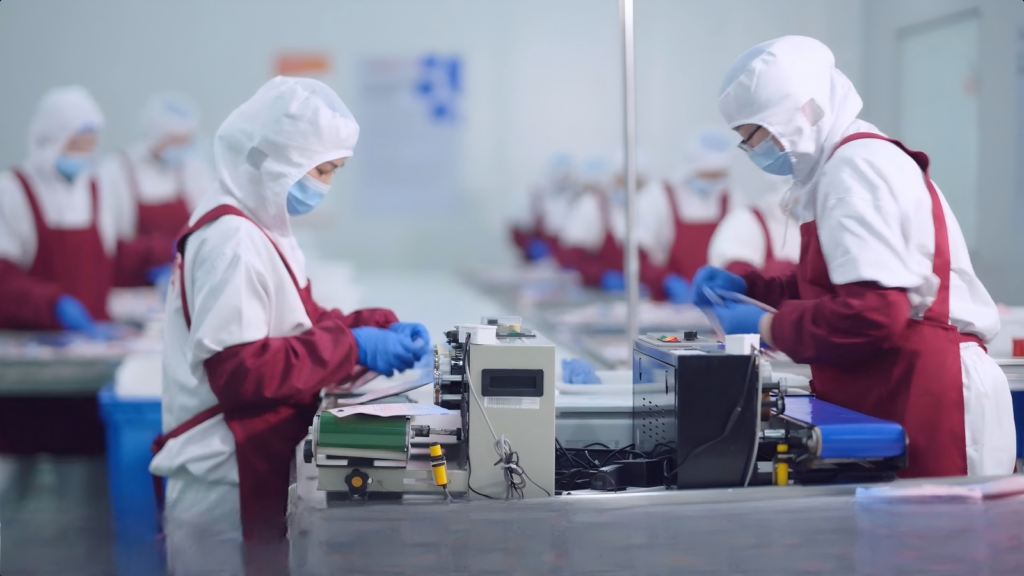
Packaging affects both shelf presentation and product protection.
A visually attractive pouch is not useful if it cannot maintain product quality throughout storage and distribution.
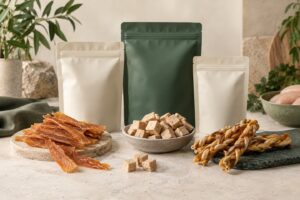
Discuss pack size, pouch structure, zipper requirements, oxygen or moisture protection, printing method, label format, units per carton and export carton specifications.
For custom printed packaging, also ask whether the packaging supplier has a separate MOQ from the food manufacturing MOQ.
This distinction is important because packaging requirements can sometimes determine the practical first-order volume.
Understand MOQ Before Comparing Prices
MOQ is one of the most important commercial variables in private label manufacturing.
However, buyers often treat it as a single number.
In practice, MOQ may be affected by the product, formula, production line, packaging format, number of SKUs and custom printing requirements.
A manufacturer quoting a lower MOQ is therefore not automatically the better option.
You should compare total inventory exposure, packaging commitments, unit economics and reorder requirements.
For a deeper explanation, see Private Label Dog Treat MOQ Explained.
For selected private label dog chew projects, Matchwell currently lists MOQ starting from 500 kg, while the final MOQ depends on the specification, SKU allocation and packaging requirements.
Don’t Compare Manufacturers on Price per Kilogram Alone
Two quotations that appear similar may represent very different products.
Protein content, raw material grade, piece size, moisture specification, packaging, testing requirements and allowable variation can all affect cost.
Before comparing quotations, confirm that manufacturers are quoting against the same basic specification.
Otherwise, the lowest quotation may simply represent a different product.
Buyers should also distinguish between product cost and total landed cost.
Packaging, inland transport, export handling, freight, duties and destination-country expenses can significantly affect the final cost of inventory.
Ask for Samples Before Making a Commercial Decision
Samples help buyers evaluate whether a supplier can translate a written requirement into an acceptable product.
When reviewing samples, do not look only at whether the dog likes the treat.
Evaluate dimensions, weight consistency, colour, aroma, texture, moisture, breakage, packaging and the overall presentation of the product.
For products containing natural meat, some variation is expected.
The important issue is whether the variation remains within an acceptable commercial specification.
Also confirm whether the sample represents an existing stock product or the actual specification that will be used for your order.
The distinction matters.
What Should You Ask Before Ordering?
Before placing an order, the discussion should cover product specification, quality requirements, packaging, MOQ, lead time, testing, export experience, payment terms and how deviations or quality issues are handled.
You should also confirm how changes are approved.
If the manufacturer changes a raw material supplier, packaging material or important process parameter, does your agreement require notification?
For a more detailed buyer checklist, read what to ask a private label dog treat manufacturer before ordering.
Red Flags When Choosing a Dog Treat Manufacturer
Be cautious when a supplier cannot clearly explain where products are manufactured, which facility certifications apply, how batches are tested or how product specifications are controlled.
Extremely low quotations also deserve investigation.
Instead of immediately assuming the offer is attractive, ask what raw material, packaging, testing and product specification the price actually includes.
Another warning sign is excessive agreement.
A professional manufacturer should sometimes tell you that a requested formula, claim, packaging format, target price or timeline is unrealistic.
Technical pushback can be a sign that the supplier understands manufacturing constraints.
Factory Audits and Visits
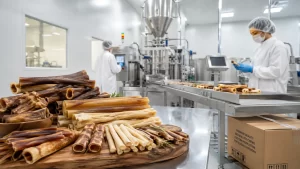
For significant private label projects, a factory visit or qualified third-party audit can provide information that is difficult to obtain from a catalogue.
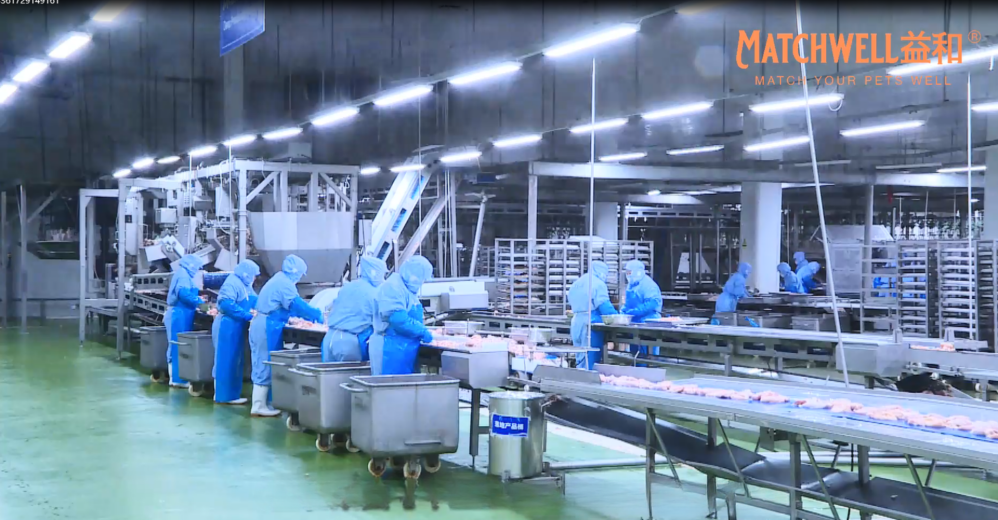
During an audit, look at raw material storage, production hygiene, personnel flow, equipment condition, in-process controls, laboratory procedures, finished-product storage and traceability records.
You should also compare what you see with what was presented during the sales process.
If travel is impractical, buyers can request documentation, live video inspections or independent third-party audits depending on the value and risk level of the project.
From Sample to Commercial Production
A reliable development process should move through clearly defined approval stages.
First, the buyer sends a product brief.
The manufacturer then reviews feasibility and proposes an existing or customized product route.
Samples are produced and evaluated.
Once the product is approved, packaging specifications, artwork, labelling and commercial terms are confirmed.
A trial or first production order can then be used to evaluate consistency, packaging execution, communication and delivery performance before the relationship scales.
This approach reduces the risk of moving directly from an attractive catalogue image to a large inventory commitment.
Think About the Second Order, Not Only the First
The first production run receives most of the attention during supplier selection.
Long-term performance is often determined by the second, fifth and tenth order.
Can the supplier reproduce the same specification?
Can they maintain raw material quality?
Can they respond when demand increases?
Can they communicate early when something changes?
Private label manufacturing is ultimately a repeatability business.
A supplier that produces an excellent sample but cannot reproduce it consistently is not a strong manufacturing partner.
Choosing Products With Commercial Potential
Manufacturing capability matters, but choosing the right SKU matters just as much.
Before requesting a custom formula, evaluate whether the product has a clear reason to exist in your target channel.
The strongest private label concepts normally combine a recognizable product format with a clear consumer proposition, appropriate pricing and packaging that fits the retail environment.
Brands planning their next product range can also review Matchwell’s analysis of 2026 private label pet treat opportunities.
Why Consider Matchwell as a Private Label Manufacturing Partner?
Matchwell focuses on B2B pet food and pet treat manufacturing for private label, OEM and ODM customers.
Available product categories include dog treats, freeze-dried products, chews, wet food and functional pet nutrition products.
For buyers developing private label dog chews, selected projects currently support MOQ from 500 kg, standard samples in approximately seven days after specifications are confirmed, and typical production lead times of around 15–20 days after sample approval, order confirmation and deposit.
Final requirements depend on the product, formula, packaging and order plan.
Matchwell also presents food safety and quality management certifications and uses raw-material inspection, production inspection and third-party examination as part of its quality-control approach.
The objective is not simply to place your logo on an existing bag.
A good private label project should align the product specification, manufacturing process, packaging and commercial positioning with the market you actually plan to enter.
FAQ
What is a private label dog treats manufacturer?
A private label dog treats manufacturer produces dog treats that another company sells under its own brand. Depending on the supplier, services can range from existing products with custom branding to fully customized OEM/ODM development.
What is the difference between private label and white label dog treats?
White label normally starts with an existing manufacturer product that multiple buyers may be able to brand and sell.
Private label may involve more customization in the product specification, packaging or commercial presentation.
Because suppliers use these terms differently, buyers should confirm exactly what can be customized.
What is a typical MOQ for private label dog treats?
There is no universal MOQ.
It depends on the treat type, production process, packaging, number of SKUs and degree of customization.
For selected Matchwell dog chew projects, MOQ currently starts from 500 kg, subject to final specification and packaging requirements.
Can I customize the formula?
This depends on the manufacturer and product category.
Possible changes may include protein selection, ingredient composition, product dimensions, texture, shape and other specifications.
More extensive changes normally require additional development and sampling.
Can manufacturers provide private label packaging?
Many OEM manufacturers can coordinate private label packaging.
However, packaging may have its own printing MOQ, setup requirements and production timeline, so these should be confirmed separately from the food MOQ.
Should I request samples before placing an order?
Yes.
Samples allow you to evaluate the product specification, appearance, texture, packaging and manufacturer communication before committing to a commercial production run.
Conclusion: Choose a Manufacturing Partner, Not Just a Product
Choosing between private label dog treats manufacturers is one of the most important sourcing decisions behind a pet treat brand.
Do not base the decision only on catalogue variety or the lowest unit price.
Evaluate the manufacturer’s food safety systems, category experience, quality controls, customization capability, packaging support, MOQ structure and ability to reproduce an approved specification consistently.
Most importantly, think beyond the first order.
The right manufacturing partner should be capable of supporting your current product while helping your brand develop additional SKUs and scale into larger orders over time.
If you are sourcing jerky, freeze-dried treats, training snacks or private label dog chews, contact Matchwell with your destination market, target product, packaging requirements and expected order volume to discuss suitable OEM or private label options.