
Private Label Dog Treat MOQ Explained: What Buyers Need to Know Before Ordering
Launching a private label dog treat brand is easier than ever. Thanks to modern OEM and ODM manufacturing, retailers, Amazon sellers, distributors, and entrepreneurs can create their own branded dog treats without building a factory.
However, one question appears in almost every buyer’s first conversation with a manufacturer:
“What is your MOQ?”
MOQ, or Minimum Order Quantity, is one of the most important factors when selecting a wholesale dog treat manufacturer. It directly impacts startup costs, inventory risk, pricing, packaging options, and overall business growth.
Many buyers assume lower MOQ is always better. In reality, understanding how MOQ works can help you negotiate better pricing, launch products more efficiently, and build a profitable private label dog treat brand.
In this guide, we’ll explain everything you need to know about dog treat MOQs, what influences them, typical industry standards, and how to find the right balance between cost and flexibility.
What Does MOQ Mean in Private Label Dog Treat Manufacturing?
MOQ stands for Minimum Order Quantity.
It is the smallest quantity a manufacturer is willing to produce for a specific product, packaging format, or customization project.
For example:
| Product Type | Typical MOQ |
|---|---|
| Standard Dog Treat Formula | 500–2,000 bags |
| Customized Formula | 2,000–10,000 bags |
| Freeze Dried Dog Treats | 1,000–5,000 bags |
| Functional Dog Treats | 3,000–10,000 bags |
| Retail Display Box Packaging | Higher MOQ |
| Stock Packaging with Label Sticker | Lower MOQ |
MOQ exists because manufacturing involves fixed costs that remain relatively similar whether producing 500 bags or 50,000 bags.
These costs include:
- Raw material sourcing
- Production setup
- Machine cleaning
- Quality inspections
- Packaging preparation
- Labor
- Warehousing
Manufacturers need a minimum volume to make production economically viable.
Why Do Dog Treat Manufacturers Have MOQs?
Many first-time buyers believe factories set MOQs simply to increase profits.
That’s rarely the case.
MOQs are largely driven by operational efficiency.
Raw Material Purchasing Requirements
Suppliers often purchase ingredients in bulk.
Examples include:
- Chicken meat
- Duck breast
- Beef liver
- Fish oil
- Probiotics
- Packaging film
Ingredient suppliers may themselves have minimum purchasing quantities.
A manufacturer cannot realistically purchase 20 kilograms of a specialized ingredient if its supplier requires 500 kilograms.
Production Line Efficiency
Every production run requires:
- Equipment setup
- Formula verification
- Quality testing
- Packaging calibration
Whether producing 1,000 bags or 20,000 bags, these preparation costs remain similar.
Higher production volumes spread those costs across more units, lowering costs per bag.
Packaging Production Requirements
Packaging is often the biggest MOQ driver.
Packaging suppliers usually have minimum quantities for:
- Printed pouches
- Retail cartons
- Display boxes
- Labels
- Shrink sleeves
Custom printed packaging typically requires significantly higher MOQs than stock packaging.
Typical MOQ by Dog Treat Category
Not all dog treats have the same minimum order requirements.
Let’s examine common product categories.
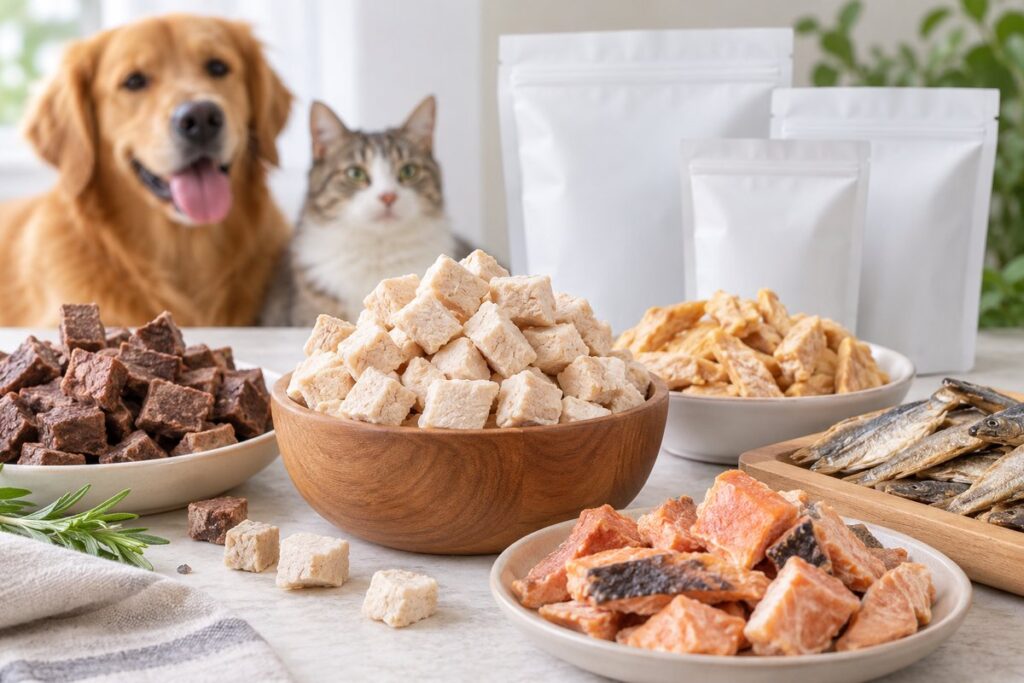
Freeze Dried Dog Treats
Freeze dried treats are one of the fastest-growing premium categories.
Typical MOQ:
- Stock formula: 500–1,000 kg
- Private label packaging: 1,000–3,000 bags
- Fully customized product: 3,000–5,000 bags
Because freeze drying equipment is expensive and production cycles are lengthy, MOQs tend to be higher.
Popular Products
- Freeze dried chicken cubes
- Freeze dried duck bites
- Freeze dried beef liver
- Freeze dried salmon treats
Soft Chew Functional Treats
Functional treats often contain active ingredients such as:
- Glucosamine
- Chondroitin
- Probiotics
- Fish oil
- Collagen
Typical MOQ:
- Existing formula: 2,000–5,000 units
- Custom formula: 5,000–10,000 units
Custom functional products require additional formulation and testing.
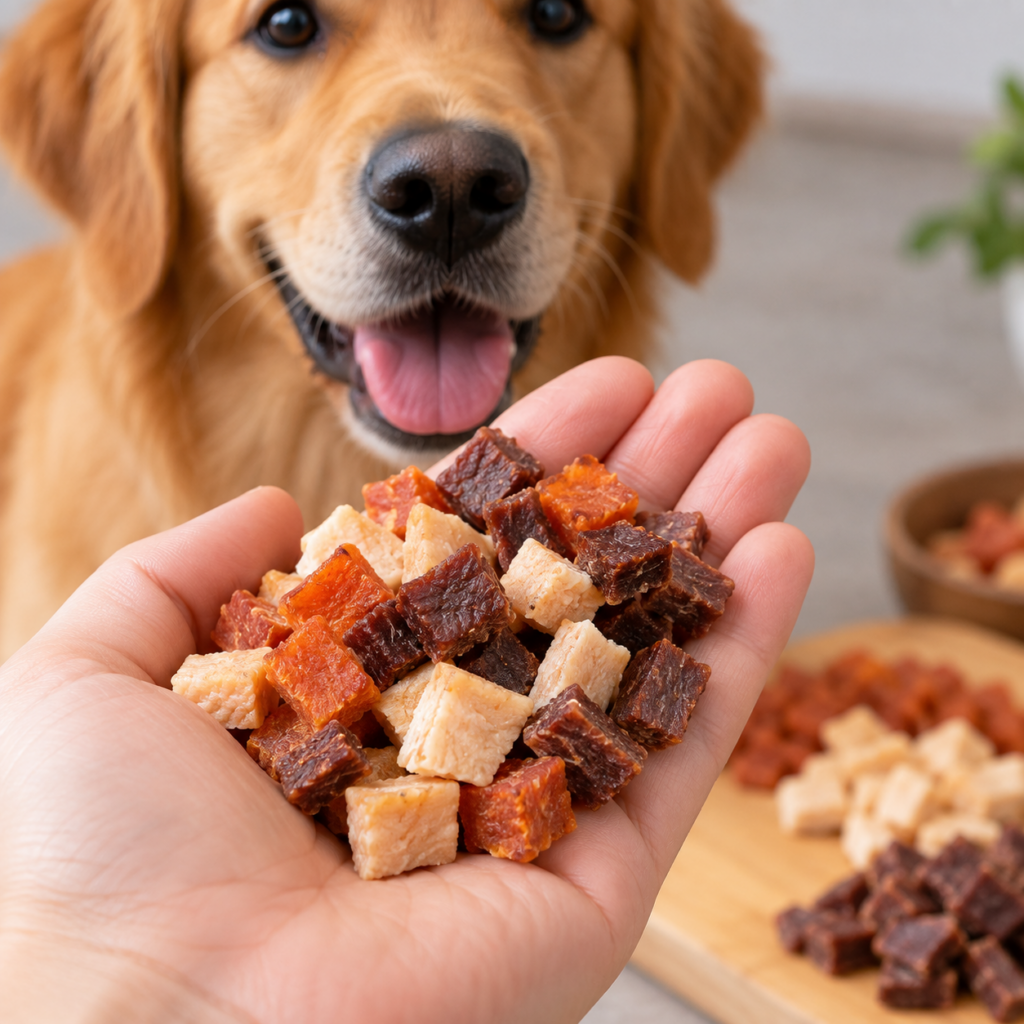
Jerky Dog Treats
Jerky products generally offer moderate MOQ requirements.
Typical MOQ:
- Standard recipe: 1,000–3,000 bags
- Customized recipe: 3,000–5,000 bags
Popular options include:
- Chicken jerky
- Duck jerky
- Beef jerky
- Sweet potato wrapped chicken
Dental Dog Treats
Dental sticks often require specialized molds and production equipment.
Typical MOQ:
- Standard products: 2,000–5,000 bags
- Custom shapes: 5,000+ bags
How Packaging Impacts MOQ
Many buyers are surprised to discover that packaging often determines MOQ more than the treat itself.
Stock Packaging
Using standard packaging can dramatically reduce MOQ.
Advantages:
- Faster launch
- Lower investment
- Faster lead times
- Easier market testing
Many startups begin with stock pouches plus custom stickers.
Fully Printed Packaging
Custom printed bags create stronger branding but increase MOQ.
Advantages:
- Professional appearance
- Better shelf impact
- Improved customer trust
- Higher perceived value
However, packaging suppliers may require:
- 5,000 bags
- 10,000 bags
- Even higher quantities for certain materials
Low MOQ vs High MOQ: Which Is Better?
The answer depends on your business stage.
Benefits of Low MOQ
Low MOQ is ideal for:
Startups
You can test:
- Different flavors
- Market demand
- Packaging designs
Without large inventory risks.
Amazon Sellers
Many Amazon businesses prefer lower MOQs because:
- Inventory storage costs are lower
- Product testing is easier
- Cash flow remains flexible
New Distributors
Low MOQ allows distributors to evaluate market acceptance before scaling.
Benefits of Higher MOQ
Higher MOQs often provide significant advantages.
Lower Cost Per Unit
Manufacturers achieve greater efficiency at higher volumes.
This usually results in:
- Better margins
- More competitive retail pricing
- Improved profitability
More Customization
Higher-volume orders often unlock:
- Exclusive formulas
- Unique shapes
- Premium packaging
- Custom ingredients
Better Supplier Relationships
Larger orders typically receive:
- Priority production
- Better pricing
- Faster support
- Greater flexibility
How to Reduce MOQ Without Sacrificing Quality
Many buyers successfully negotiate lower MOQs by making strategic decisions.
Use Existing Formulas
Developing a completely new recipe increases costs and MOQ.
Using an established formula often reduces minimum requirements significantly.
Choose Standard Packaging First
Many successful brands start with:
- Generic pouches
- Private labels
- Sticker applications
After proving market demand, they upgrade to fully printed packaging.
Consolidate Multiple Flavors
Instead of ordering:
- 500 bags chicken
- 500 bags duck
- 500 bags beef
Consider launching with one or two flavors first.
This concentrates purchasing power and reduces complexity.
Work With Experienced OEM Manufacturers
Factories specializing in private label projects often provide more flexible MOQ options.
They understand the needs of:
- Amazon sellers
- Startups
- Retail chains
- Pet distributors
Questions to Ask a Dog Treat Manufacturer About MOQ
Before selecting a supplier, ask these questions:
Is MOQ based on weight or units?
Different manufacturers calculate MOQs differently.
Does MOQ change with custom packaging?
Packaging often affects MOQ more than formulation.
Can multiple flavors be combined to reach MOQ?
This flexibility can reduce inventory risk.
Are there separate MOQs for packaging and products?
Sometimes packaging suppliers impose different requirements.
Do prices decrease significantly at higher volumes?
Understanding volume discounts helps with future planning.
Common MOQ Mistakes Buyers Make
Choosing the Lowest MOQ Supplier
A lower MOQ doesn’t always mean a better deal.
Consider:
- Product quality
- Certifications
- Manufacturing experience
- Consistency
Ordering Too Many SKUs
Launching with five flavors sounds exciting.
But it often creates:
- Excess inventory
- Cash flow pressure
- Operational complexity
Many successful brands begin with one or two products.
Ignoring Packaging Costs
Buyers often focus solely on product MOQ.
Packaging frequently becomes the largest hidden expense.
Underestimating Sales Cycles
Retail distribution and Amazon growth take time.
Ordering excessive inventory too early can create storage and cash flow challenges.
MOQ Trends in the Pet Treat Industry for 2026
Several trends are reshaping private label manufacturing.
More Flexible Manufacturing
Many OEM factories now offer:
- Lower startup MOQs
- Hybrid packaging solutions
- Faster product launches
To attract emerging brands.
Growing Demand for Premium Treats
Higher-value categories such as:
- Freeze dried dog treats
- Functional treats
- Limited ingredient treats
Continue growing worldwide.
Many buyers are willing to accept slightly higher MOQs for premium products with stronger margins.
Increased Private Label Competition
As more retailers launch their own brands, manufacturers are investing in flexible production models to support smaller customers.
Final Thoughts
MOQ is not simply a number on a quotation sheet.
It reflects manufacturing economics, packaging requirements, raw material sourcing, and production efficiency.
The lowest MOQ is not always the best choice. The ideal MOQ balances:
- Cash flow
- Inventory risk
- Unit cost
- Branding goals
- Long-term scalability
For most startups, beginning with a focused product line, standard packaging, and an experienced OEM partner provides the fastest path to market.
As sales grow, transitioning to larger orders and customized packaging can significantly improve margins and strengthen brand identity.
For businesses exploring wholesale dog treats, private label dog treats, or wholesale freeze dried dog treats, partnering with an experienced manufacturer can help optimize MOQ requirements while maintaining quality and profitability.
Frequently Asked Questions
What is a typical MOQ for private label dog treats?
Most manufacturers require between 500 and 5,000 units, depending on formulation and packaging customization.
Why are freeze dried dog treat MOQs usually higher?
Freeze drying equipment is expensive and production runs are longer, requiring larger volumes to maintain efficiency.
Can I start a private label dog treat brand with a low MOQ?
Yes. Many manufacturers offer stock formulas and standard packaging that significantly reduce minimum order requirements.
Does custom packaging increase MOQ?
Almost always. Printed packaging suppliers often require higher minimum quantities than stock packaging.
Is a lower MOQ always better?
Not necessarily. Higher MOQs often provide lower unit costs, better margins, and more customization opportunities.