
Wet Cat Food Texture Specifications for Private Label Brands
Wet cat food texture needs a clearer specification than “soft,” “meaty” or “premium.” A buyer may imagine visible pieces surrounded by a light gravy, while the manufacturer may interpret the same brief as small particles in a thicker sauce. Both samples can look reasonable and still create different customer experiences.
For private label brands, defining the intended texture early helps make quotations, sample reviews and production acceptance more consistent. The useful reference is the finished food in its intended retail pack, assessed under agreed conditions.
Separate Texture From Nutritional Positioning
Start by identifying the product’s intended feeding role, target life stage and destination market. Then define its physical format. Gravy, jelly, loaf and broth describe presentation; they do not establish whether a particular recipe is suitable as a complete daily diet.
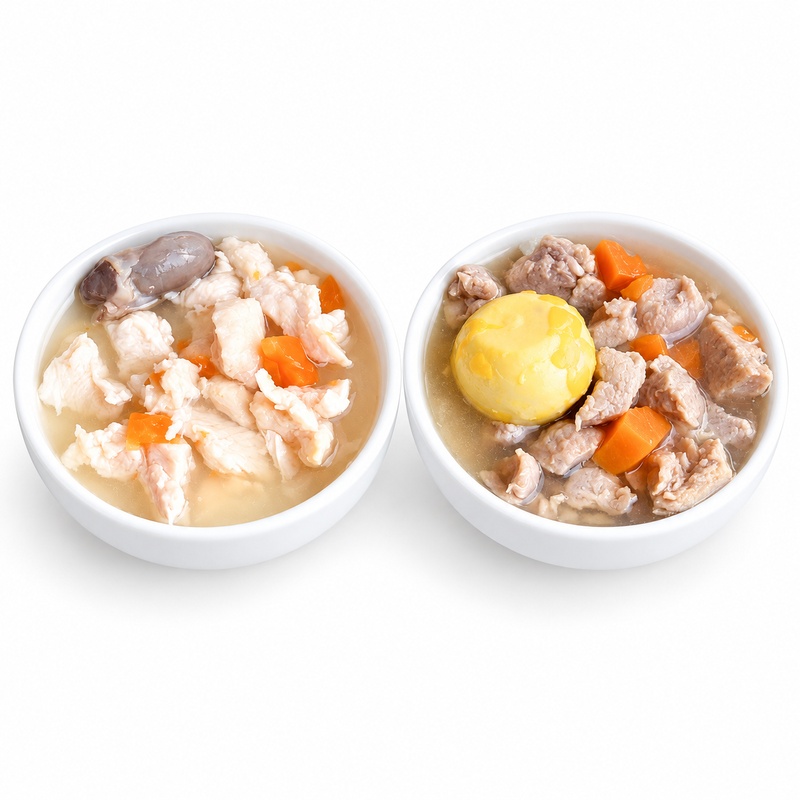
Matchwell’s wet cat food range presents gravy, jelly, loaf and broth formats, with private label and OEM/ODM services. Use these categories to begin a product discussion, then confirm the specific recipe, nutritional specification and packaging available for your project.
Keep nutritional approval and texture approval as separate parts of the brief. A visually attractive product still needs the appropriate formulation and supporting information for the feeding purpose stated on its label.
Describe What the Customer Will See and Serve
Translate the desired eating and serving experience into observable features. Describe what happens when the pack opens, when the food is transferred to a bowl and when a spoon passes through it.
| Format | Features to define | Useful review method |
| Chunks in gravy | Piece dimensions, piece integrity and gravy distribution | Photograph an undisturbed portion, then transfer it using a consistent method |
| Pieces in jelly | Jelly firmness, distribution and release from the pack | Compare samples at the same temperature and record how they separate |
| Loaf or pate | Surface appearance, uniformity and ease of portioning | Use the same spoon movement and compare the portion left in the pack |
| Shreds in broth | Shred dimensions, liquid appearance and distribution | Inspect the complete contents before stirring and document the result |
These are proposed review criteria. Agree the actual methods and tolerances with the manufacturer for the chosen formula. Avoid copying a numeric target from an unrelated product that uses different ingredients or processing.
Make the Meat and Sauce Description Measurable
Terms such as “more meat” and “less gravy” can hide several different requests. One buyer may mean larger visible pieces. Another may mean a higher proportion of pieces in the opened pack. A third may be referring to the recipe’s ingredient declaration.
Keep those questions separate. Visible solids are not automatically the same measurement as declared meat content. If the project requires a solids-to-liquid assessment, define the sample preparation and measurement method before comparing results.
For example, draining conditions, waiting time and the treatment of gelled material can affect the result. The supplier and buyer should use the same agreed procedure. A photograph remains useful for appearance, but it cannot replace an agreed analytical or physical method.
Review the Product After Its Intended Manufacturing Process
An early development sample can help establish a direction. Before commercial approval, confirm how closely the sample represents the intended recipe, container, fill weight and manufacturing process. Document any remaining differences.
A published AFB International study examined eight wet-food palatants and found that thermal processing could change their color and composition. It also assessed selected palatants in processed food. That research supports evaluating flavor systems after relevant processing; it does not establish the performance of a Matchwell formula. [1]
For your project, review texture in the finished sealed pack after the agreed process and cooling conditions. Ask the manufacturer to evaluate any recipe or packaging change that could affect the process. Thermal-process parameters should be determined by the responsible specialists for the actual product and container.
Use the Same Conditions for Every Sample Review
Record the sample code, production date, formula revision, pack format and storage history. Bring comparison samples to the same agreed review temperature, and use the same dishes, utensils and handling sequence.
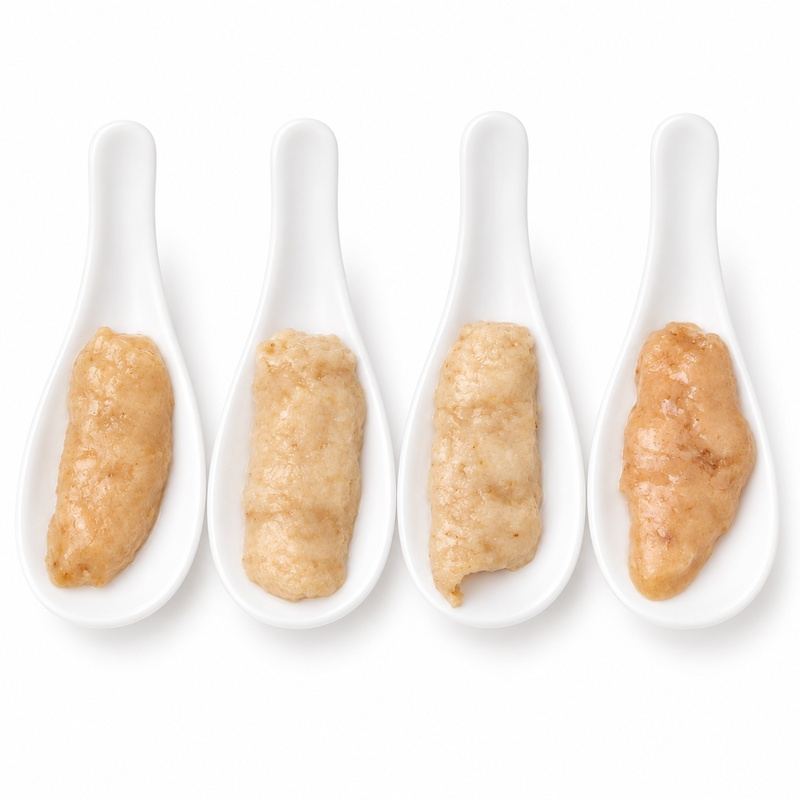
Open the pack and photograph the contents before mixing. Then record how easily the product leaves the container, whether the pieces remain intact and how the liquid or gel is distributed. If measurements are part of the specification, identify the method and equipment used.
Review several packs rather than selecting the most attractive one. Keep individual results visible so a pooled impression does not hide variation. The number of packs and sampling locations should reflect the project stage and the question being investigated.
Turn the Approved Sample Into a Production Reference
Approval should leave a record the production and quality teams can use. Link the accepted sample to a controlled specification and identify which characteristics are essential, which allow normal variation and which require investigation.
Record the agreed appearance descriptions, photographs, applicable measurements and acceptance criteria. Keep reference materials under a defined retention arrangement; an old opened sample is not a stable long-term benchmark.
Ask how the manufacturer will evaluate samples from the production run and document changes to ingredients, piece preparation or packaging. If a later lot differs, compare its records with the approved specification before deciding whether the difference is acceptable.
Consider Texture During Storage and Distribution
Include the intended shelf-life program in the project discussion. Establish when samples will be examined and which appearance, texture, packaging and other quality attributes will be recorded. Fresh production samples provide only one point in the product’s life.
A transport evaluation can also help identify whether the pack and secondary packaging preserve the intended presentation. Use the handling conditions relevant to your route. Shelf-life and transport conclusions should come from the actual product and packaging combination.
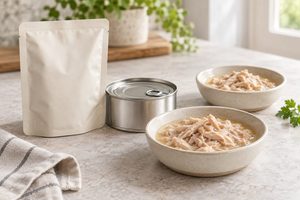
For a comparison of primary packaging options, see wet cat food pouches versus cans. Keep texture requirements consistent when assessing either format.
Frequently Asked Questions
Which wet cat food texture is best
There is no single best choice for every brand or cat. Select a format that fits your intended customer and positioning, then evaluate the finished product, including appropriate feeding assessment.
Can I ask the manufacturer to match a reference product
Yes. Explain which features matter: piece dimensions, sauce distribution, serving behavior or overall appearance. Also state your ingredient, nutritional, packaging and cost requirements so the reference can be assessed realistically.
Is a thicker gravy always a higher quality product
No. Gravy thickness is a design characteristic. The useful question is whether it meets the agreed product specification and supports the intended serving experience.
Prepare Your Wet Cat Food Brief With Matchwell
Developing a private label wet cat food range? Contact Matchwell Pets with your target market, intended feeding role, protein preferences, desired texture, pack format, opening quantity and launch schedule.
Include a reference photo or product if available, and explain what you want the customer to see when the pack is opened. A specific texture brief gives the team a clearer basis for discussing samples and a quotation.