
Private Label Dog Treats in Canada
1. Introduction: The Private-Label Opportunity in Canada’s Dog Treats Market
If you’re a wholesaler, distributor, or retailer in Canada thinking about entering the private-label pet treats business, now is a very exciting time. The Canadian pet snacks and treats market is growing rapidly, and private-label or white-label dog treats are becoming an increasingly attractive way to tap into this booming demand.
In this article, we’ll walk through the landscape of private-label dog treats in Canada: why the market is hot, what trends are driving it, how to partner with a manufacturer, and what to watch out for — all from the perspective of someone looking to make smart, data-driven moves.
2. The Big Picture: Canadian Pet & Treats Market Size
To understand why private label dog treats are becoming so relevant, it’s important to start with the scale and momentum of the broader pet market in Canada.
- According to Mordor Intelligence, the Canada pet food market is estimated at USD 5.38 billion in 2025, with a projected CAGR of 5.53% through 2030. Mordor Intelligence
- The pet snacks and treats segment is growing even faster: per Grand View Research, the Canada pet snacks & treats market is expected to reach USD 4,421.7 million by 2030, growing at a CAGR of 12.8% from 2025–2030. Grand View Research
- When you narrow to the natural dog treats niche, it’s also on fire: forecasted to grow at 14.5% CAGR from 2025 to 2030, reaching USD 830.5 million. Grand View Research
- On private-label share specifically: older data shows private-label brands hold about 8.1% of pet food market share in Canada. open.alberta.ca
These numbers underscore the scale and opportunity: the treats category is growing faster than the broader pet food market, and there’s room for private-label players to gain share.
3. Key Trends Driving Private Label Dog Treats in Canada
Several current trends are fueling the rise of private-label dog treats. Understanding them can help you develop differentiated and future-proof products.

3.1 Premiumization & Humanization
- Pet owners are treating their dogs more like family. This has translated into higher demand for premium and health-forward products.
- There’s growing interest in natural, clean-label treats. Owners expect transparency, quality ingredients, and traceability.
3.2 Regulatory & Traceability Pressures
- Recent reforms to Canadian feed regulations are pushing companies to improve traceability and preventive controls. That favors manufacturers who can demonstrate quality systems. Mordor Intelligence+1
- For private-label customers, aligning with a manufacturer that already has robust compliance systems can save time and risk.
3.3 The Surge in Canadian Brand Preference
- Domestic demand is rising. While some Canadians still buy international brands, there’s a growing appetite for Canadian-made or Canadian-sourced pet products.
- Retailers are responding: big Canadian pet specialty retail chains like Pet Valu (800+ stores across 10 provinces) offer broad reach and are likely very receptive to differentiated private-label products. Q4cdn
3.4 Premium & Human-Grade Treats
- The human-grade pet food market is also expanding in Canada. For instance, Grand View Research estimates human-grade pet food in Canada reached USD 87.8 million in 2024, with snacks/treats being among the fastest-growing types. Grand View Research
- This trend is particularly attractive for premium private-label positioning: imagine high-quality, human-grade dog treats tailored to health-conscious buyers.

4. Why Choose Private Label (or White Label) Dog Treats
For wholesalers, retailers, and OEM/ODM customers, there are several compelling reasons to consider private-label dog treats:
- Brand differentiation
- You can offer a unique product line (flavor, ingredients, packaging) that aligns with your brand identity.
- Standing out is especially valuable when many big brands dominate shelf space.
- Higher margins
- Private-label typically comes with better margin potential than reselling established national brands.
- You control pricing, positioning, and cost structure more directly.
- Flexibility
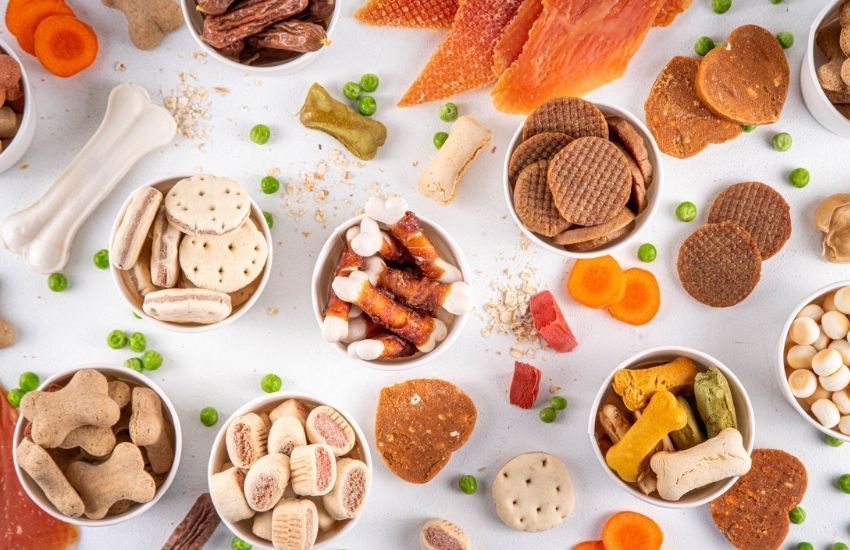
- You decide formulation: natural treats, functional treats (joint, dental, gut health), limited-ingredient, freeze-dried, chewables, etc.
- You can adapt quickly to consumer trends without depending on a single brand’s R&D timeline.
- Regulatory advantage
- Working with a manufacturer that already meets Canadian regulatory standards means less burden on you to build compliance from scratch.
- A good manufacturer can also manage traceability, third-party quality checks, and food safety testing.
- Scalable growth
- As demand grows (note the high CAGR in the snack/treats space), your private-label range can scale.
- You can start small (e.g., regionally, online) and expand to larger retail chains or cross-border.

5. Challenges & Considerations in Private Label Dog Treats
It’s not all smooth sailing — there are risks and operational hurdles to navigate.
- Minimum order quantities (MOQs): Manufacturers may require high MOQs. That’s common, but you should negotiate or find partners that match your scale.
- Quality control: Ensuring consistent quality, especially for treats (chews, freeze-dried, soft), is critical. You’ll want a manufacturer with strong food safety systems.
- Logistics & shelf-life: Some treats (e.g., baked, freeze-dried) require special handling or packaging to maintain freshness.
- Regulatory compliance: Even for private label, you are responsible for your brand’s label claims, ingredient disclosures, and compliance with Canadian feed regulations.
- Brand building: Private-label means you’ll likely need to invest in marketing, packaging design, and education to get buyer confidence.
6. How to Source a Private Label Manufacturer — What to Look For
If you’re looking to partner with a manufacturer (like Matchwell Pets), here’s a practical checklist:
- Experience & Capability
- Do they have experience in dog treat categories (chewy treats, baked biscuits, freeze-dried, functional)?
- Can they scale production up or down based on demand?
- Quality & Compliance
- Are they certified (e.g., food safety certifications, third-party lab testing)?
- What traceability systems do they have in place?
- How do they manage allergen risk, contamination, and shelf-life stability?
- R&D Support
- Can they help with formulation, flavor development, or functional ingredients?
- Do they provide private-label or white-label turnkey solutions (packaging, labeling, design)?
- MOQ & Pricing
- What are their minimum order quantities?
- Do they offer flexible pricing for scaling?
- What is the cost per unit, and how does it change with volume?
- Logistics & Supply Chain
- Can they manage cold chain (if needed), moisture control, and shelf-life packaging?
- Do they support cross-border logistics if you’re distributing nationally?
- Customer References & Case Studies
- Ask for references from other private-label clients.
- Review case studies where they helped retailers or wholesalers bring a treat line to market.
- Sustainability & Ingredient Sourcing
- If sustainability is important to you, check whether they source responsibly (e.g., sustainable proteins, recyclable packaging).
- Do they have transparency on ingredient origins?
7. Use Cases: How Wholesalers & Retailers Can Leverage Private Label Treats
Here are a few practical models for how different types of buyers can use private-label dog treats:
- Specialty Pet Retailer: Launch your own treat line branded under your store name. Offer unique flavors and treat types not found in big national brands. Use this to deepen customer loyalty.
- Big Box or Supermarket Chain: Create a private-label treat program to offer a value or premium tier under your store brand, distinguishing your pet-food aisle.
- Online Wholesale Distributor: Bundle private-label treats into your catalog to provide differentiated SKUs to smaller retailers, grooming shops, or independent online pet shops.
- Subscription Box Company: Use private-label chews or freeze-dried bites to make your box proprietary and unique.
- Corporate Gifting or Promotional Use: Use branded dog treats as corporate gifts or promotional items — an emerging segment among pet-savvy businesses.
8. Why Matchwell Pets Is a Strong Partner for Private Label Treats
At Matchwell Pets, we specialize in OEM/ODM manufacturing for pet treats — including private-label and white-label dog treats tailored to your needs.
- We offer full customization: from recipe to packaging.
- As a certified factory, we adhere to strict food safety and third-party testing protocols.
- We support scalability: whether you’re launching regionally or across Canada (or beyond), we can scale with you.
- Our innovative R&D team can help develop trending products: functional treats, natural ingredients, freeze-dried meats, chewy training bites, and more.
If you’re looking to build out a private-label pet treat line that aligns with Canadian market trends, you can learn more and start a conversation here: Matchwell Pets.
9. Real-World Examples & Success Stories
- Canadian retailers are increasingly promoting domestic brands and even their own private-label options, especially within specialty pet stores.
- Major Canadian pet retail chains like Pet Valu (800+ locations) are key distribution partners for private-label items. Q4cdn
- Private-label growth is backed by data from industry sources: a boom in private labels in treat categories is noted in trade publications. GlobalPETS
10. Steps to Get Started (Your Private Label Roadmap)
Here’s a step-by-step plan to launch your private-label dog treat line in Canada:
- Market Research
- Analyze Canadian pet treat trends (e.g., natural, functional, human-grade).
- Identify your target customers (retailers, subscription boxes, specialty shops).
- Define Product Concept
- Choose treat formats (chews, biscuits, freeze-dried, soft).
- Decide on ingredients (natural, limited-ingredient, functional).
- Sketch packaging and branding ideas.
- Find & Vet Manufacturer
- Use the checklist above to evaluate production partners.
- Request samples and run QC testing.
- Regulatory & Compliance Setup
- Ensure labeling meets Canadian feed regulation standards.
- Establish quality assurance procedures, traceability, and testing plans.
- Pilot Production
- Start with a small batch to test demand.
- Gather feedback from early customers or partners.
- Scale Up
- Increase production as you validate product-market fit.
- Expand into wider retail or online channels.
- Marketing & Sales
- Develop your own branding (even if it’s “private-label”).
- Create sales materials (spec sheets, nutrition profiles) for wholesale buyers.
- Use EDI or other systems to integrate with large retailers if needed.
- Continuous Optimization
- Monitor sales, quality, and consumer feedback.
- Iterate on formulas, packaging, or SKUs based on performance.
11. Risks to Mitigate & How to Handle Them
- Demand risk: Start with conservative forecasts; don’t overcommit to huge MOQs until proven.
- Quality risk: Require your manufacturer to run regular microbial, heavy-metal, or shelf-life testing.
- Regulatory risk: Stay updated on Canadian feed regulation changes; partner with a manufacturer that does too.
- Brand risk: Even private-label needs an identity. Make sure your packaging and design communicate value and trust.
- Logistics risk: Work out distribution early — especially for fragile or perishable treats (freeze-dried or soft).

12. Conclusion: Seize the Private-Label Treat Moment in Canada
The Canadian dog treat market — especially the private-label segment — is at a compelling inflection point. With strong macro demand, rising premiumization, regulatory shifts, and a growing appetite for Canadian-made products, now is a strategic moment for wholesalers, retailers, and OEM/ODM players to launch or expand a private-label dog treat business.
By partnering with a reliable, quality-focused manufacturer like Matchwell Pets, you can build a differentiated, scalable treat line that resonates with Canadian buyers and drives long-term growth.